

2nd Sunday in Ordinary Time (Year A) - 18 January 2026
18th January 2026
“O Lamb of God, Who takes away the sin of the world, look upon us and have mercy upon us; You Who art Yourself, both victim and priest, Yourself, both Reward and Redeemer, keep safe from all evil those whom You have redeemed, O Saviour of the world.” - St Irenaeus of Lyons
A reflection on today's Gospel by the Venerable Archbishop Fulton J Sheen:
As Christ refused titles of external power, so also John refused titles which the Pharisees were willing to confer on him, even the greatest, that he was the One sent by God.
The next day Our Lord was in the crowd, and John saw Him at a distance. Immediately, John reached back into the Jewish heritage of symbol and prophecy, known to all his hearers.
“Look, this is the Lamb of God; Look, this is He Who Takes away the sin of the world.” (John 1:29)
John was affirming that we must not look first for a teacher, a giver of moral precepts, or a worker of miracles. First we must look for One Who had been appointed as a sacrifice for the sins of the world. The Passover was approaching, and the highways were filled with people driving or carrying their one-year-old lambs to the temple to be sacrificed. In full view of those lambs, John pointed out the Lamb Who, when sacrificed, would end all sacrifices in the temple, because He would take away the sins of the world.
John was the parting voice of the Old Testament, in which the lamb played such an important role. In Genesis, we find Abel offering a lamb, the firstling of his flock, in a bloody sacrifice for the expiation of sin. Later on, God asked Abraham to sacrifice his son Isaac—a prophetic symbol of the Heavenly Father sacrificing His own Son. When Isaac asked, “Where is the lamb?” Abraham said:
“My son, God will see to it That there is a lamb to be sacrificed.” (Genesis 22:8)
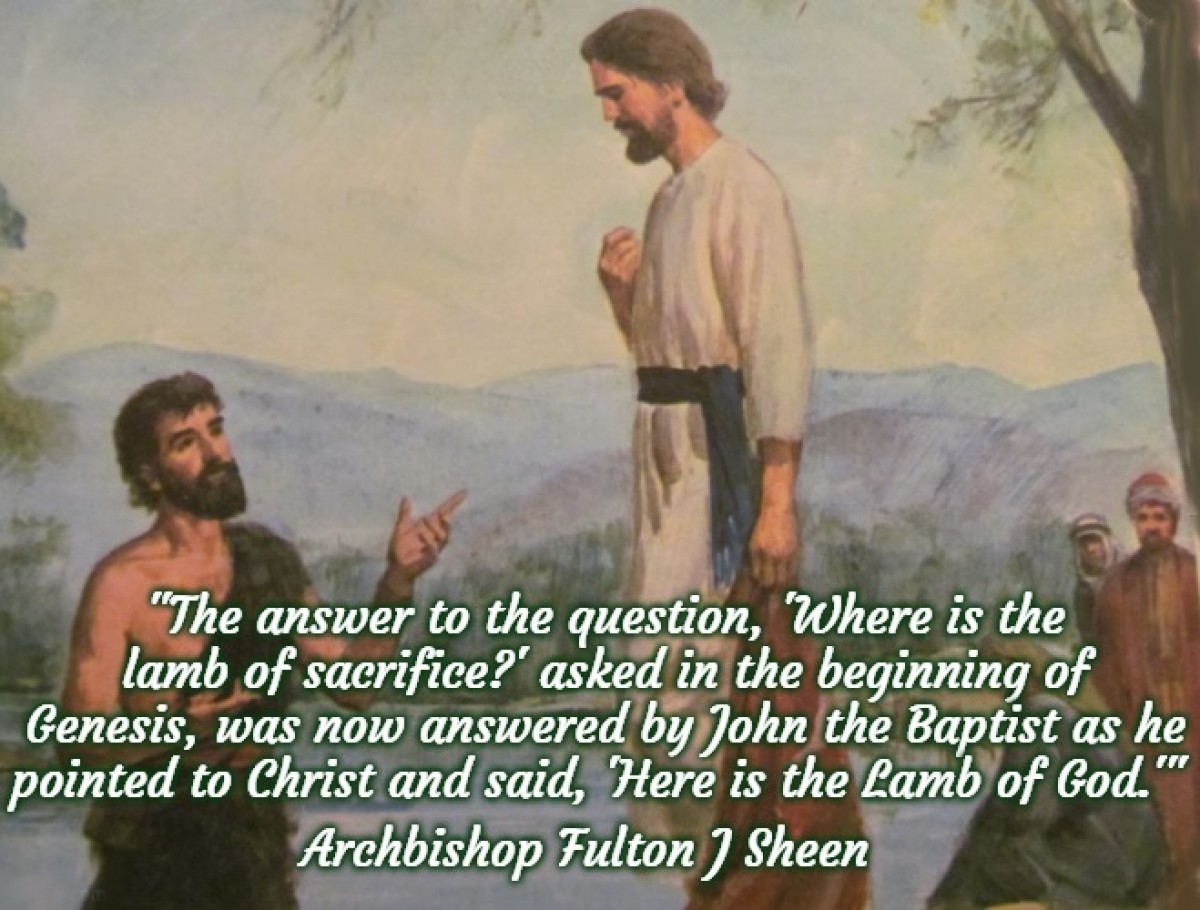
The answer to the question, “Where is the lamb of sacrifice?” asked in the beginning of Genesis, was now answered by John the Baptist as he pointed to Christ and said, “Here is the Lamb of God.” God had at last provided a Lamb. The Cross that had been defended in the wilderness during the temptations was now showing itself over the Jordan.
Every family sought to have its own Paschal Lamb; and those who were now taking their lambs to Jerusalem, where the Lamb of God said that He must be sacrificed, knew that the lamb was a symbol of Israel’s deliverance from the political slavery of Egypt. John was saying that it was also a symbol of deliverance from the spiritual slavery of sin.
The Lamb would come in the form of a man; for the prophet Isaias had foretold:
“And God laid on His shoulders our guilt, the guilt of us all. A victim? Yet He Himself bows to the stroke; No word comes from Him.” (Isaiah 53:7)
The lamb was most often used as a victim of sacrifice, because of its innocence and mildness; therefore, it was an emblem most suited to the character of the Messiah. The fact that John the Baptist called Him the Lamb of God is most significant; He was neither the peoples’ lamb, nor the lamb of the Jews, nor the lamb of any human owner, but the Lamb of God. When the Lamb was finally sacrificed, it was not because He was a victim of those who were stronger than Himself, but rather because He was fulfilling His willing duty of love for sinners. It was not man who offered this sacrifice, although it was man who slew the victim; it was God Who gave Himself.
The phrase which John the Baptist used to describe how the Lamb of God would “take away” the sins of the world is one which is parallel in Hebrew and in Greek; Leviticus describes the scapegoat which “Will carry away all their sins into a land uninhabited set at large in the desert.” (Leviticus 16:22)
As the scapegoat on which sins were laid was driven out of the city, so the Lamb of God Who really took away sins would be driven from the City of Jerusalem.
Thus, the Lamb which God promised to provide Abraham for his sacrifice, and all the subsequent lambs and goats offered by Jews and pagans throughout history, derived their value from the Lamb of God Who stood before John. Here it was not Our Lord who was prophesying the Cross; rather it was the Old Testament through John, declaring Him to be a Divinely appointed sacrifice for sin and the only remover of human guilt.
(Life of Christ)
Lamb of God
The Agnus Dei is sung during the fraction, the breaking of the consecrated Host. St John Chrysostom preached of how the fraction symbolised the Passion of Christ: “What Christ did not suffer on the Cross, He suffers in the sacrifice for thee.” The hymn itself invokes Christ and recalls His sacrificial death with overtones of a hymn of victory of the triumphal Lamb. This belief is then emphasised again when the priest holds up the fractured Host and says, “Behold the Lamb of God, behold Him who takes away the sins of the world, blessed are those called to the supper of the Lamb.”
As we celebrate the mysteries of the Mass, we look to the Lamb who suffered, died, and rose for our salvation. We must gather around the altar of the Lamb, offering to Him our own hearts and pledging to be His servants, so that we may welcome Him and become wedded to Him in the Holy Eucharist.