

The Baptism of the Lord (Year A) - 11 January 2026
11th January 2026
“See, Fire and Spirit in the womb that bore you! See, Fire and Spirit in the river where you were baptised! Fire and Spirit in our Baptism; in the Bread and the Cup, Fire and Holy Spirit! Christ, the Light of the World, dwelt first in the womb of the Virgin - who was thus ‘baptised’ by her Son - and then in the womb of the Jordan; he emerged from both as the Incarnate Word, the Saviour of mankind. Those who are baptised thus become the children of Mary and partakers of the body, blood, soul, and divinity of her Son.” - St Ephrem
A reflection on today's Gospel by the Venerable Archbishop Fulton J Sheen:
"The baptism of Jordan was a prelude to the baptism of which He would later speak, the baptism of His Passion … Thus His baptism of water looked forward to His baptism of blood. The Jordan flowed into the red rivers of Calvary. In the waters of the Jordan He was identified with sinners; in the baptism of His Death, He would bear the full burden of their guilt. In the Old Testament, the Psalmist speaks of “entering into deep water” as a symbol of suffering which is manifestly the same imagery. There was a fitness in describing agony and death as a kind of baptism.
"The Cross must have been looming up in His thoughts now with increasing vividness. It was no afterthought in His mind. He was temporarily immersed in the waters of the Jordan only to emerge again. So would He be immersed by the death on the Cross and the burial in the tomb, only to emerge triumphantly in the Resurrection. He had proclaimed His mission from the Father at the age of twelve; now He was preparing Himself for oblation.
"The sacred humanity of Christ was the connecting link between heaven and earth. The voice from heaven which declared Him to be the Beloved Son of the Eternal Father was not announcing a new fact or a new Sonship of Our Blessed Lord. It was merely making a solemn declaration of that Sonship, which had existed from all eternity, but which was now beginning to manifest itself publicly as Mediator between God and man. The Father’s good pleasure, in the original Greek, is recorded in the aorist tense, to denote the eternal act of loving contemplation with which the Father regards the Son.
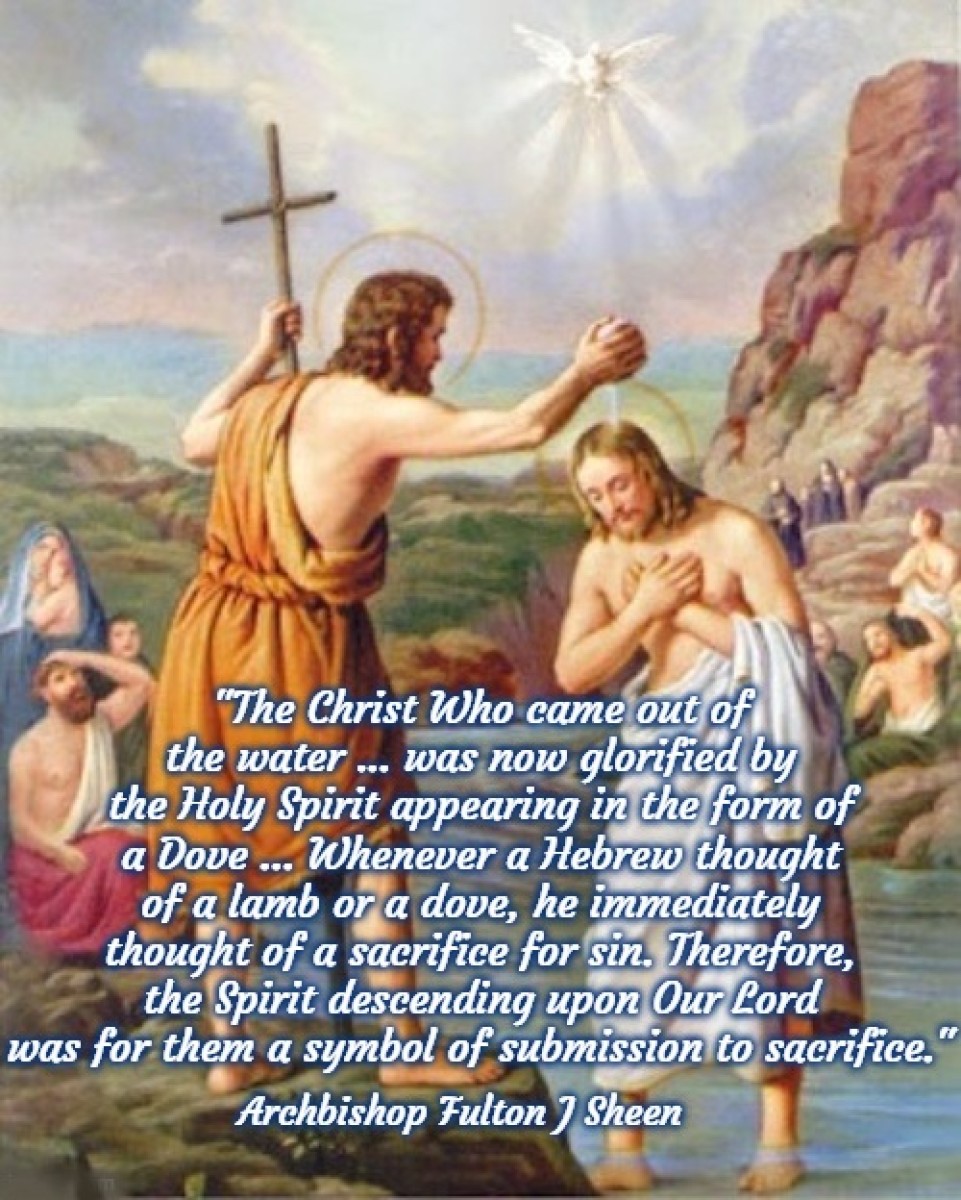
"The Christ Who came out of the water, as the earth had come out of the water at creation and after the Flood, as Moses and his people had come out of the waters of the Red Sea, was now glorified by the Holy Spirit appearing in the form of a Dove. The Spirit of God never appears in the figure of a Dove anywhere save here. The Book of Leviticus mentions offerings which were made according to the economic and social position of the giver. A man who could afford it would bring a bullock, and a poorer man would offer a lamb; but the poorest of all had the privilege of bringing doves. When the mother of Our Lord brought Him to the temple, her offering was a dove. The dove was the symbol of gentleness and peacefulness, but above all it was the type of sacrifice possible to the lowliest people. Whenever a Hebrew thought of a lamb or a dove, he immediately thought of a sacrifice for sin. Therefore, the Spirit descending upon Our Lord was for them a symbol of submission to sacrifice. Christ had already united Himself symbolically with man in baptism, in anticipation of His submergence into the waters of suffering; but now He was also crowned, dedicated, and consecrated to that sacrifice through the coming of the Spirit. The waters of the Jordan united Him with men, the Spirit crowned Him and dedicated Him to sacrifice, and the Voice attested that His sacrifice would be pleasing to the Eternal Father.
"The seeds of the doctrine of the Trinity which were planted in the Old Testament began here to unfold.
"The baptism in the Jordan closed Our Lord’s private life and began His public ministry. He had gone down into the water known to most men only as the son of Mary; He came out ready to reveal Himself as what He had been from all eternity, the Son of God. He was the Son of God in the likeness of man in all things, save sin. The Spirit was anointing Him not just for teaching, but for redeeming."
(Life of Christ)
Prayer for the Baptism of the Lord
Eternal Father, Who at the baptism of Jesus revealed Him to be Your Son, anointing Him with the Holy Spirit: grant that we may be faithful to our call as Children of God, listening to You, guided by Your Spirit, to fulfil our unique and definite purpose. Bestow upon us all the graces we need to attain that level of perfection which will make us pleasing in Your sight. Grant us the strength to be faithful followers of Christ Jesus Your beloved Son, Who lives and reigns with You and the Holy Spirit, One God for ever and ever. Amen. 💐💖🙏
What does the Church teach us about Baptism?
The Church teaches that Baptism is a fundamental sacrament in the Christian faith, serving as the gateway to spiritual life and the initiation into the Church. It is recognised as the sacrament of regeneration, which cleanses individuals from original sin and incorporates them into the body of Christ, making them children of God and heirs of heaven.
Baptism is described as the basis of the whole Christian life and is essential for salvation.
This sacrament is not merely a ritual; it signifies a profound transformation and a new beginning in the life of the believer.
The Catechism of the Catholic Church emphasises that Baptism is the door that gives access to the other sacraments, establishing a vital connection to the life of grace within the Church.
The rite of Baptism involves the use of water, which symbolises cleansing and rebirth. The invocation of the Holy Trinity during the baptismal ceremony signifies the consecration of the baptised to God and their entry into communion with the Father, Son, and Holy Spirit.
The Church holds that once Baptism is validly celebrated, it cannot be repeated and that it should be conferred as soon after birth as possible, ideally within the first few weeks. This practice is rooted in the understanding of Baptism as a necessary sacrament for salvation, the gateway to heaven, which provides the grace needed to cleanse original sin and initiate the child into the holy Church of God.